


The cybersecurity industry is full of jargon, abbreviations, and acronyms. Now that they are faced with increasingly complex attack vectors, from endpoints to networks to the cloud, many enterprises are tackling advanced threats in a new way: Extended Detection and Response, which yields yet another new acronym: XDR. And despite the fact that XDR has already become quite well established this year among leading companies in the industry and the analyst community, it is still an evolving concept, which is accompanied by a fair amount of confusion.
- What is XDR?
- How does XDR differ from EDR?
- Is it the same as SIEM & SOAR?
As a leader in the EDR market and a pioneer in the emerging XDR technology, we often receive requests to clarify what it means and how it can ultimately help the customer deliver better results. With this post, we want to answer some frequently asked questions regarding XDR and the differences between XDR and EDR, SIEM, and SOAR.
What is EDR?
EDR enables an organization to monitor endpoints for suspicious behavior and capture all activities and events. It then detects advanced threats thanks to critical context derived from correlated information and finally provides an automated response, e.g., by isolating an infected endpoint from the network practically in real-time.
What is XDR?
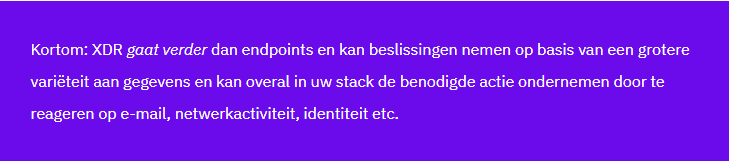
XDR is the next evolution of EDR (Endpoint Detection and ResponseWhile EDR collects and correlates activities across multiple endpoints, XDR goes further and provides detection, analysis, and response for endpoints, networks, servers, cloud workloads, SIEM, and much more.
This allows multiple tools and attack vectors to be monitored on a single screen. This improved insight enables the user to contextualize threats, which greatly benefits triage, investigation, and remediation.
XDR automatically performs the collection and correlation of data across multiple security vectors. This accelerates threat detection, allowing security analysts to respond before the threat escalates. Direct integrability and pre-configured detection mechanisms compatible with a range of products and platforms ensure improved productivity, threat detection, and forensic data.
How does XDR differ from SIEM?
When we talk about XDR, people sometimes think it is another way to describe a Security Information & Event Management (SIEM) tool. However, XDR and SIEM are two different things.
SIEM collects, aggregates, and analyzes large amounts of log data from throughout the enterprise and stores it. The initial design of SIEM was very broad: collecting available log and event data from practically everywhere in the enterprise to store it for various use cases, such as governance and regulatory compliance, rule-based pattern matching, heuristic/behavior-based threat detection such as UEBA, and scouring telemetry sources for IOCs or atomic indicators.
However, the implementation of SIEM tools involves a great deal of fine-tuning and effort. Furthermore, security teams can become overwhelmed by the large number of alerts they receive from a SIEM, which could cause the SOC to overlook critical alerts. Moreover, it is still a passive analytical tool that issues alerts, even though a SIEM captures data from dozens of sources and sensors.
The XDR platform aims to solve the challenges of the SIEM tool for the effective detection of and response to targeted attacks and includes behavioral analysis, threat intelligence, behavioral profiling, and analytical investigation capabilities.
Would you like to learn more about the SentinelOne Singularity Platform? Please contact us or request a free demo.







You must be logged in to post a comment.